

An xt called stanley, p.1
An XT Called Stanley, page 1


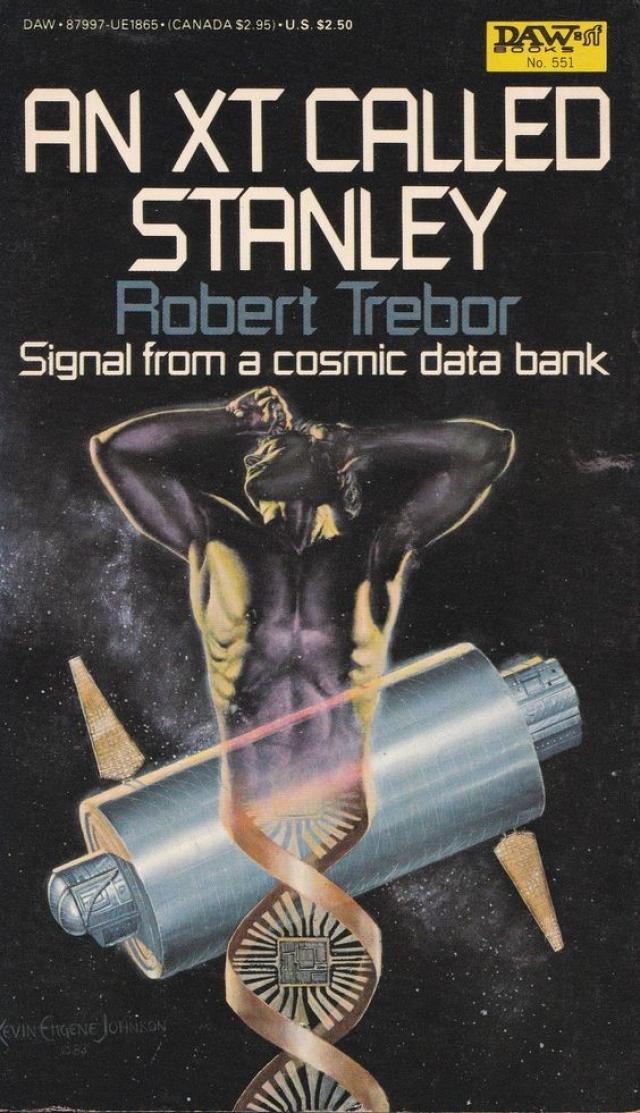
Stanley came to us across the reaches of interstellar space from a distant civilization of vast technical powers.
According to the Steward Interviews, Stanley was an evil intelligence that took control blurnof me and others of “weak character.” Dr. Steward would have us believe that through his heroic intervention Stanley was prevented from enslaving the world. I have another story to tell and now, sixteen years later, I am free to tell it. No doubt Dr. Steward and others will claim that I am lying or have been brainwashed by this evil intelligence, but all I ask is for you to read, my account with an open mind and judge for yourselves where the truth lies. ...
ROBERT TREBOR is well qualified to write on scientific speculations for he is a professor of mathematics and of physics at a large Eastern university and has been a major lecturer at many scientific conferences in the United States, Europe and Japan. Although this is his first novel, there is a ring of authenticity about it that derives from personal knowledge of the inner workings of academic minds and research institutions. Robert Trebor, it should be noted, is a pen-name.
AN XT CALLED STANLEY
Robert Trebor
DAW BOOKS, INC.
DONALD A. WOLLHEIM, PUBLISHER
1633 Broadway,
New York, NY 10019
COPYRIGHT ©, 1983, BY ROBERT TREBOR
ALL RIGHTS RESERVED.
COVER ART BY KEVIN JOHNSON.
ISBN: 0-87997-865-1
FIRST PRINTING, OCTOBER 1983
1 2 3 4 5 6 7 8 9
To Mary
PRINTED IN U.S.A.
CONTENTS
Chapter I CONCEPTION
Chapter II GESTATION
Chapter III BIRTH
Chapter IV DEBUT
Chapter V PROBATION
Chapter VI FREEDOM
Chapter VII DESTRUCTION
CHAPTER I Conception
Welcome to New Hope. You have been selected out of a large pool of highly qualified applicants for the privilege of working at New Hope. Here in space, competence and reliability are essential for our very survival. If you fail to comply with the rules and regulations or fail to show a cooperative attitude, your employment will be terminated immediately. Since employment in space is a privilege, no reason need be given for termination.
New Hope is the largest free city in space with almost forty thousand inhabitants. The circumference of New Hope is four kilometers and the width is 1.2 kilometers. The gravity on level one is 6.9 meters per second per second. This is approximately two thirds Earth gravity at sea level. The apparent gravity is caused by the rotation of New Hope about its central axis at precisely one revolution per minute. You should be used to the lower gravity in a week or so. If you feel nauseous, anti-nausea pills can be purchased at the vending pharmacy at Fourth Alley Central.
From the “Welcome to New Hope Manual”
2046 edition, revised annually
This is the story of Stanley. Most of the hundreds of people who knew him thought of him as a friend, someone they could call at any hour and he would be glad to see them. Yet his friendly smile, his dark wavy hair, and even his shelves of old books only existed on the viewscreens of New Hope. Stanley was an electronic being, a computer made of silicon, carbon and silver. Though we supplied the materials, the intelligence that was Stanley was not the creation of our technology. Stanley came to us across the reaches of interstellar space from a distant civilization of vast technical powers. He came to meet us and we destroyed him.
According to the Steward Interviews, Stanley was an evil intelligence that took control of me and others of “weak character.” Dr. Steward would have us believe that through his heroic intervention Stanley was prevented from enslaving the world. I have another story to tell and now, sixteen years later, I am free to tell it. No doubt Dr. Steward and others will claim that I am lying or have been brain washed by this evil intelligence, but all I ask is that you read my account with an open mind and judge for yourselves where the truth lies.
Stanley arrived in December of 2051 in the form of a radio signal. The loudest part of the signal was a series of beeps. If “b” stands for a beep and “—” a silence, then the signal sounded like this:
“b—b—bb—bbb—bbbbb—bbbbbbbb—bbbbbbbbbbbbb—bbbbbbbbbbbbbbbbbbbbb—bbbbbbbbbbbbbbbbbbbbbbbbbbbbbbbbb——b—b—bbb—bbbbb—bbbbbbbb—bbbbbbbbbbbbb—bbbbbbbbbbbbbbbbbbbbb—”
The signal was beeping out the first nine numbers of the Fibonacci sequence over and over again. This beeping was picked up on a radio frequency assigned to the military. Despite repeated warnings that unauthorized use of military frequencies was a Federal offense, the beeping continued.
By January of 2052 Dr. Maxwell Stanton at the New Hope Institute for Space Studies was consulted on the possibility that the signal was coming from an extraterrestrial source. And this is precisely what Dr. Stanton found. The signal was coming from an antenna outside our solar system somewhere between us and the galactic core. That’s in the direction of the constellation Sagittarius. A closer examination of the signal showed that this beeping was only to draw our attention to a much fainter signal on a higher frequency. This fainter signal was a complex communication containing millions of volumes of information. Somewhere between here and the center of our galaxy there was a civilization trying to make contact with us.
But I’m getting ahead of myself. My story begins in March of 2052 when I checked in at the Kennedy Space Center on Cape Canaveral. I was bound for New Hope and not too happy about it. My career plans had been derailed and I had to accept employment in space on a secret project. All I knew of the project was that it wasn’t weapons work but it was classified. Before checking in I stopped to have my last cigarette.
The New Hope experience begins at the Cape with a baptism in a pool filled with insecticides and fungicides. It’s total immersion. There’s no way to avoid it because across the middle of the pool there’s a panel of glass that comes down below the surface of that oily liquid. To get across the pool you have to duck down under the glass. Everyone holds their nose. When you get to the other side they let you shower the stuff off. Then they give you a paper suit to wear during a day of poking and probing.
No stone is left unturned. I even had to admit to a psychologist that I had never been to bed with a woman. “You’ll save us both a lot of time if you’ll answer truthfully,” a white-coated inquisitor informed me.
“It’s not that I’m queer or anything,” I said defensively. “It’s just that I haven’t had time for girls. I’ve been working very hard. It’s not everyone who has a Ph.D. from Harvard at twenty-two.”
But my inquisitor was unimpressed. “I’m not here to make judgments,” she told me. She went on to inquire about my eating habits. Apparently my lack of experience with women had no more significance than my dislike for broccoli, for in spite of these defects I was cleared for passage to New Hope. There was one more pool of insecticides and fungicides to cross and on the other side we were reunited with our possessions. By now the stainless steel trunks we had packed the week before had been thoroughly inspected and baked in a 90°C oven. We were allowed to wear our own clothes on the trip up.
The trip up was an eighteen-hour nightmare of nausea and self-pity. Each view of Earth only reminded me of how complete was my exile. Everything familiar receded until the grand cities of the eastern seaboard were barely discernible smudges amid a sea of blue and a swirl of clouds.
I first saw New Hope when I awoke from a fitful sleep. There it was, a giant coffee can turning slowly in the blazing sun. The silvered mirrors which lined the outer surface of New Hope like louvers of a venetian blind flashed dazzling images of the sun. A voice explained that New Hope was on its cooling trend so the mirrors were set to reflect the sunlight out into space. During a warming trend which would begin in two weeks, the mirrors would be set to let the sunshine in. The seasons of New Hope ran in a six-week cycle between a summer of 25°C to a winter of 15°C.
The voice drew attention to the row of lifeboats that circled New Hope. In the unlikely case of an emergency, each lifeboat could return one hundred and forty-five passengers to the earth’s atmosphere for a fiery re-entry and a parachute drop into the Pacific. With my habit of making rough estimates I surmised that there were barely enough lifeboats to take down half of New Hope’s forty thousand inhabitants.
As we passed over the north end of New Hope the camera zoomed in for a close-up view of the inner surface of New Hope, catching a group of nude sunbathers. One particularly buxom girl looked up at us and waved, treating us to a full view of her as she lay back in the blazing sunshine. I turned away in embarrassment before I realized there was no way she could know I was looking at her. When I looked back the sunbathers were out of view. Someone behind me felt called upon to comment, but his witticisms were cut short by the warning bell. We were about to disembark for New Hope.
When the buses arrived to ferry passengers from the ship to New Hope, it was total chaos. Four buses arrived, each bringing fifty passengers bound for Earth. The whole bewildering exchange had to take place in ten minutes. The buses clamped onto the four sections of the ship. It was important to go to the correct door at the correct time. Invariably some fool messes it up. When the door scanner detected I was headed for the wrong bus, a stewardess kindly informed me that New Hope was no place for idiots. I was the last person to strap down on my bus while everyone glared at me. A moment later we were falling away from the ship. We were bound for New Hope.
Aroun d the circumference of New Hope amid the mirrors that regulate the temperature there runs a road, complete with dotted white line down the middle. This is the landing road. We found ourselves barrelling toward that road at 240 kilometers per hour. We drew closer and closer until we were almost touching the road. I looked up at the road and saw that it was moving right along with us. Suddenly there was a buzzing sound and then a jarring clang. Something had caught the bus roof, clamping it to the road. Now there was gravity. The landing road and all of New Hope was now above us. A door in the top of the bus swung open and an escalator descended. We had arrived. I waited for most of the others to depart before boarding the escalator which would carry me up into New Hope.
At the top of the escalator there was a row of entry gates. When I held up my I.D. bracelet for the scanner, a voice said, “Welcome to New Hope, Dr. Trebor. Your luggage will be waiting for you at your apartment.”
“Where’s that?” I asked.
“Level 2, Alley 9, Corridor 16, Apartment 37.”
“How do I get there?” I asked.
“Consult the map in the Arrival Hall,” the voice replied. “Please make way for the next passenger.”
There was no one behind me but the computer didn’t know that. The computer was through with me. It would be pointless to continue the conversation. This was New Hope, warm, friendly New Hope. If someone had offered passage back to Earth I would have gladly accepted. In quiet desperation I wandered out into the Arrival Hall. In the hall there were electric banners welcoming the employees of Kraft and Steig, the Union of Space Workers, and Military personnel. Women dressed in uniforms of red and blue collected their charges under their company banners. Most of the passengers either joined a group or confidently headed off to their destinations. There were about twenty of us left wandering about without a shepherd.
On the far side of the hall I noticed a young woman apparently giving directions. She was just under seventeen decimeters tall and she had dark hair pulled back in a pony tail tied with a red ribbon. Her face was bright and she talked with animation.
“Fifty Alley is blocked here,” she said, pointing to the map on the wall, “so you better take Sixth Alley and cross over. So many of the alleys and corridors have been blocked off by the military, you may end up feeling like one of Skinner’s rats in a maze. Unfortunately the blocked passages aren’t indicated on the map. But I know Sixth is clear on all levels.”
The man she was talking to thanked her and started off. Then a woman wearing a green jumpsuit asked her where the Steig dorm was. I moved closer to ask her how to get to my apartment.
“Dr. Trebor?” she called out suddenly, interrupting herself in mid sentence. She was looking at me as if I were her long lost uncle.
“Yes,” I confirmed.
“I knew you were tall,” she said, coming up to me. “I’m Jean Odell. I’m a secretary at the Institute. I came to meet you. Just give me a few moments to answer some questions and I’ll be with you.” She turned back to the woman in the green jumpsuit. Then there was a black man wearing a white Nehru jacket, then a host of others. It took almost half an hour for her to get everybody taken care of. Even after we left the Arrival Hall we ran into passengers who were obviously lost. Jean spotted their confusion and stopped to help them out.
“I’m sorry this has taken so long,” she apologized to me. “You’d think they’d have someone here to give directions.”
I nodded agreement. “Boy, it’s colder here than I expected,” I said to make conversation. “I saw sunbathers as we were approaching.”
“They showed you the nude sunbathers,” Jean said with a smile.
“How did you know?’ I asked. I could feel myself blushing.
“They show that to everybody. It’s all on tape.”
“Tape?” I said. “That wasn’t real?”
“New Hope’s full of illusions. Sometimes it’s hard to tell what’s real and what’s not.”
“You’re real?” I said on the spur of the moment.
“Yes,” she said, smiling. “I’m real. Would you like to see the real view of New Hope above ground?”
I nodded and she led me to an elevator. When the elevator started up I pitched backwards and hit the back wall. It was as if the elevator was lurching forwards as well as going up. “Oh, I forgot to warn you,” Jean said.
“That’s the coriolis force,” I blurted out when I realized what it was. New Hope is a cylinder spinning in space at exactly one revolution per minute. The spin provides a centrifugal acceleration, an artificial gravity about two thirds as strong as Earth’s gravity. In the lower gravity your step is springier and for the first few weeks you’re apt to slip if you change directions too quickly. Because of the spin, you experience a force pushing you toward the back of an elevator when it is speeding upwards toward the central axis of New Hope. It’s not all that strong but if you’re not expecting it you can lose your balance.
“You see, our velocity is proportional to the distance from the axis of rotation,” I said as if I were explaining the phenomenon to a class of physics students. “As we move upwards the distance between us and the axis of rotation decreases and thus our velocity due to rotation decreases. A change in velocity means an acceleration perpendicular to our apparent motion. Now an acceleration…” I looked at Jean and realized she wasn’t following. I felt ridiculous. I wanted to stop but having started there seemed to be nothing to do but go on. “An acceleration means an apparent force pushing you toward the back of the elevator,” I said, ending as quickly as possible.
“I see,” she said, tilting her head to one side to look at me. “No one ever explained it to me before.”
We went outside. To say outside is funny when you think about it because outside is really inside. New Hope is a cylinder with the people living on the sides. The dorms and apartments, the offices, the production areas and the military complex are packed in layers, five deep, around the sides of New Hope. Above this maze of rooms and corridors is what the residents of New Hope call the “outside.” In New Hope when you say, “Let’s go outside,” you mean, “Let’s go to the open area in the interior of New Hope.”
The outside was lit with sunlight brought in through huge glass windows in the north end of New Hope. When we came out of the elevator onto a gravel path, the light gave the impression of approaching sunset. Jean explained that the trees and shrubs lining the path were made of glass. It was hard to believe, they looked so real. The path was on high ground overlooking New Hope’s two rivers, the quiet Black River for swimming and water skiing, and the raging White River for riding rapids. We watched as a raft of people were buffeted and bounced along until the river dumped them laughing and screaming into a quiet collecting pool beside one of the three pumping stations.
“You can fish in the White River,” Jean said. “For about twice the price of a cafeteria dinner they’ll give you a line and reel and if you catch anything they’ll even cook it for you, free.”
“Does anybody catch anything?”
“Oh, sure. The river’s well stocked.”
The other river, the Black, was almost deserted. Jean explained that we were in the middle of New Hope’s cold season. “Most of the swimmers and sunbathers have gone underground to the pools and sunning areas on the lower levels. Now’s a good time for water skiing,” Jean said, pointing out a group waiting on one of the docks for a vacant tow line to come along. “‘In a couple of weeks you’d have to wait half an hour to get a free line.”
I watched a woman catch a line and start off disappearing from view behind some trees. Some minutes later I tried to find her again. I followed the curve of the river as it climbed up and up until it was arching over my head. I was looking straight up. There, a little more than a kilometer over my head were trees hanging upside down and a river which miraculously didn’t pour down on us. The view of New Hope upside down and over my head so disoriented me that I felt I might fall. I grabbed Jean to save myself. She grabbed me with both hands and said, “Look at your feet.” I obeyed.






