

Down the line, p.1
Down The Line, page 1
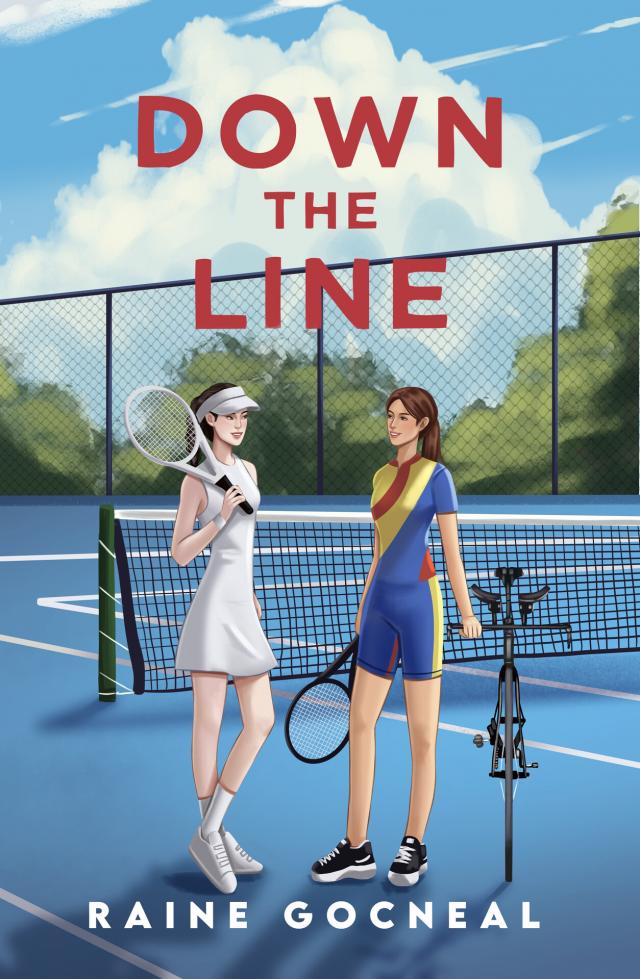


DOWN
THE
LINE
RAINE GOCNEAL
Copyright © 2026 by Raine Gocneal
All rights reserved.
No part of this publication may be reproduced, distributed, or transmitted in any form or by any means, including photocopying, recording, or other electronic or mechanical methods, without the prior written permission of the publisher.
The story, all names, characters, and incidents portrayed in this production are fictitious.
Print ISBN: 978-621-06-4836-2
Epub ISBN: 978-621-06-4835-5
PDF ISBN: 978-621-06-4837-9
Book Cover by Morimorijulie
Published by Raine Gocneal
City Camp Rd, Baguio City
Philippines
+639653348930
TABLE OF CONTENTS
DEDICATION
Dear Readers,
GLOSSARY
PLAYLIST FOR THE BOOK
CHAPTER 1
CHAPTER 2
CHAPTER 3
CHAPTER 4
CHAPTER 5
CHAPTER 6
CHAPTER 7
CHAPTER 8
CHAPTER 9
CHAPTER 10
CHAPTER 11
CHAPTER 12
CHAPTER 13
CHAPTER 14
CHAPTER 15
CHAPTER 16
CHAPTER 17
CHAPTER 18
CHAPTER 19
CHAPTER 20
CHAPTER 21
CHAPTER 22
CHAPTER 23
CHAPTER 24
CHAPTER 25
CHAPTER 26
CHAPTER 27
CHAPTER 28
CHAPTER 29
CHAPTER 30
CHAPTER 31
CHAPTER 32
CHAPTER 33
CHAPTER 34
CHAPTER 35
ACKNOWLEDGEMENT
ABOUT THE AUTHOR
To all the queer athletes, those who are afraid to love and come out, and those who continue to chase their journeys of greatness with courage and pride.
Dear Readers,
I never imagined that I would write a story about tennis.
I grew up loving volleyball, and during my senior years, I found myself drawn into athletics. For years, it became my home; the adrenaline, the relentless training, the quiet discipline, and the community that understood both the victories and the losses. But when I entered college, my focus shifted. I poured my energy into my degree, slowly stepping away from the athlete’s life that once defined me.
Then came tennis.
I stumbled upon a tennis match on a livestream. I don’t know what it was, but I was instantly hooked. From then on, I began watching matches obsessively, learning the rules, the strategies, and the stories behind the players. Tennis fascinated me in a way I never expected.
Eventually, that fascination led me to tennis sapphic stories and to the realization that there were so few of them. That scarcity stayed with me. I wanted to contribute something new, something honest, for future readers and for people like me who are searching for sapphic representation in sports, not only in tennis but also in disciplines that rarely find themselves in the spotlight, like triathlon.
Writing this book from an athlete’s perspective, I knew accuracy mattered. I researched extensively and leaned on my own experiences to bring the matches, races, trainings, and behind-the-scenes moments to life. I wanted to portray the physical exhaustion, the mental battles, the quiet sacrifices, and the deep love athletes have for their sport. I may not have captured every detail perfectly, but I hope this story gives you a genuine glimpse of what it means to be an athlete both on and off the field.
This book is for the tennis sapphic community, to the triathlon community, and to every queer athlete still searching for themselves in media. It is for those who have loved a sport fiercely, stepped away from it, and found their way back in unexpected forms. We deserve stories where we are seen.
Happy Reading!
GLOSSARY
TENNIS:
Ace / Service Ace - a legal serve that lands in the correct service box and is not touched by the opponent's racket, winning the point immediately for the server
Backhand - a fundamental stroke hit on the side of your body opposite your dominant hand
Baseline - the solid line at the very back of the court
Breakpoint - when the receiver is one point away from winning the game on the server's serve
Crosscourt - hitting the ball diagonally across the net to the opposite side of the court
Decider - It is the set played when both sides are tied in sets, and the winner of this set wins the overall match
Double Fault - the server fails to get the ball in play legally on both their first and second attempts for the same point
Down The Line - striking the ball parallel to the sideline, aiming it straight along the edge of the court
Forehand - a fundamental groundstroke hit on the same side of the body as your dominant hand
Grand Slam - the accomplishment of winning all four major tournaments (Australian Open, French Open or Roland-Garros, Wimbledon, US Open) in a single calendar year, or to the tournaments themselves, which are the most prestigious events in tennis, offering the most points and prize money.
Holding Serve - winning a game when you are the one serving
Player's Box - the designated seating area courtside where a player's support team; coaches, family, physios, agents, sits to watch and support them during a match
Rally - the continuous back-and-forth exchange of shots between players after the serve
Return - the shot hit by the receiver to hit the opponent's serve back into play
Slice Serve - a type of serve causing the ball to curve and skid low after bouncing, pulling the opponent wide off the court
Sliding Backhand - a defensive, athletic maneuver where a player runs, lunges, and slides on the court to reach an extremely wide or deep ball
Topspin - the forward rotation of the ball, causing it to dip sharply and bounce high, allowing players to hit harder and keep the ball in play
Transition Volleys - aggressive shots hit by a player moving forward from the baseline towards the net
Winner - a shot that directly wins the point because the opponent can't return it
TRIATHLON:
Discipline - swimming, cycling, and running, performed sequentially in one continuous race
Hotshot - discretionary picks selected for their high potential to disrupt the competition
Split Time - the amount of time taken to complete a specific segment or discipline within the overall race
T100 - a professional and amateur race series featuring a standardized 100km distance (2km swim, 80km bike, 18km run)
Transition Zone - the designated area where athletes change gear and clothing between the swim, bike, and run segments. T1 (swim-to-bike) and T2 (bike-to-run).
PLAYLIST FOR THE BOOK:
Here’s a playlist you can sink into. The king of feeling like having a crush for way too long. Give it a listen!
DOWN THE LINE (CURATED FOR THE BOOK)
CHAPTER 1
ALEXANDRA
There’s something grounding about being alone, especially here, tucked away in the quiet magic of El Nido. The islands feel like a kind of pause, not just from the world, but from the whirlwind that’s been my life this season. The air smells of salt and mango, the waves break softly against the shore, and for once, no one expects anything from me.
“Look who’s having a great time!” Dad says as he sits down beside me. He hands me a fresh coconut, already cracked open.
“Is watching the ocean out here in the sun instead of swimming or kayaking your definition of a good time?” I tease, taking the coconut from him.
He chuckles, stretching his legs out in front of him. “Kid, when you hit my age, you’ll understand that sitting still is a sport in itself. Besides, someone’s gotta make sure you’re not running yourself into another injury.”
I roll my eyes but smile anyway. “You just don’t want to admit you’re scared of the kayak tipping over again.”
“That was one time,” he says, mock offended. “And the current was ridiculous.”
I laugh, letting the sound fade into the hush of the sea. I should be in London right now, training with my twin brother, chasing a run at Wimbledon. Instead, I’m here, nursing a shoulder that refuses to cooperate.
The injury didn’t announce itself with drama. Just a quiet warning at first, a twinge that sharpened day by day until I couldn’t pretend it was nothing anymore. The timing couldn’t have been crueler. I’d finally found my rhythm. My hardcourt game was peaking, and the momentum from my first Grand Slam final at the Australian Open still buzzed through me, even if I’d finished runner-up.
Pulling out felt like slamming the brakes just as the road opened up. Worse, it felt like I’d let everyone down, the sponsors who’d taken a chance on me, the fans already whispering my name. Disappointment sat heavier than the pain itself, and the guilt of not living up to all that expectation burned in a way my shoulder never could.
“You know,” Dad says after a while. “This... this is the good part. The in-between. Don’t rush it.” A small smile tugged at his mouth. “You’re already at the end of your recovery, love. The hardest part’s behind you. Just a little more patience, and you’ll be back where you belong.”
I sigh. “Easy for you to say, Dad. You're not the one gett ing picked apart online. Everyone keeps saying that I’m just riding on my twin brother’s coattails.”
He turns to me then, and the softness in his eyes sharpens into something steadier.
“They don’t know you,” He says, his voice steady but kind. “And they don’t get to decide who you are. You reached the Australian Open final because of your own work. And even before tennis, you built a name for yourself in triathlon.”
“I’m impressed your dad still has wisdom left in him,” Mom teased as she stepped onto the sand, handing me a bowl of mango slices in hand and sitting beside Dad with a sigh.
“You act like I’ve been quiet all these years,” Dad muttered, and Mom ignored him.
Her eyes landed on me, “You know what’s funny? You always forget where you started. You were thirteen when you picked up a racket seriously. Thirteen. That’s retirement age in tennis years,” she said, eyes on me.
I smiled faintly, remembering those early years. The awkward grip, the blisters and the endless frustration.
“You weren’t like Archie,” Dad chimed in. “He had a racket in his hand before he could spell his own name. But you? You were swimming laps before you could even tie your shoes.”
“Yeah, but tennis and triathlon aren’t the same. Tennis… I had to fight for every inch of it.”
Mom chuckled, shaking her head. “Well, if there’s one thing that runs in this family, it’s competitiveness. It’s in your blood, all of you.”
It was true. I grew up in a house where sweat on the floor was normal and competition was a kind of love language.
Dad, a Filipino triathlon legend and two-time Olympic gold medalist, had me in the pool before kindergarten and on running trails before I even knew what pace meant. Mom, an eleven-time Grand Slam champion from Australia, brought the precision, the endless drills, the quiet belief that repetition was its own kind of prayer.
Tennis was supposed to be Archie’s thing. My twin brother, the natural, Mom’s prodigy, and I were Dad’s. Until one summer in Brisbane, tennis became mine too.
“You didn’t get lucky,” Mom said firmly. “You worked. You caught up. You blew past girls who started ten years before you. That wasn’t luck, Alex. That was a choice.”
That made me pause. My parents weren’t the type to sugarcoat. I looked between them, then the mango bowl heavy in my lap, the waves breaking steadily in the distance.
For a long moment, I just sat there, letting the rhythm of the sea do what words couldn’t. Maybe they were right, maybe it hadn’t all been luck.
The sun had already begun to dip below the palm trees by the time I left the beach. I showered quickly, then slipped onto the bed. I reached for my phone on the nightstand and opened any social media.
The first thing on my feed was a clip from Archie’s latest press interview at Wimbledon.
Reporters laughed as he joked about British weather, his pre-match obsession with sour candy, and his inability to cook pasta without burning the water.
Then someone asked about me.
“My sister?” he said, with a proud smile. “Yeah, Alex is tough. She’s got more fight in her pinky finger than most of us do in our whole bodies. I told her I’m playing this one for her. She’s probably somewhere rolling her eyes at me for saying that, but yeah, she’s watching. And she’ll be back. Just wait.”
I smiled faintly, my heart warm and heavy all at once.
I kept scrolling.
The next clip was from earlier today, Olivia Smythe stepping off the court after her training session. Hair in a ponytail braid, white towel around her shoulders, signature smile softening her serious post-practice glow.
Olivia Smythe. Britain’s golden girl and the kind of player who makes the sport look unfair. Once she turned pro, she never once stumbled, just kept collecting titles, magazine covers, and hearts like it was her part-time job.
The crowds adore her and even the ball kids look starstruck when she smiles at them. Who can blame them? She’s got this easy charm that makes you forget she’s probably planning her next straight-sets demolition.
In the video, Olivia answered questions with the same confidence she had always shown, laughing softly and brushing strands of hair behind her ear. Her voice was charming and thoughtful, carrying that English accent I love hearing.
I stared at the screen longer than I meant to. Longer than I should’ve. Because even now, after all these years, after tournaments and injuries and everything I’d built myself into, one look at her and I was right back where it started.
I’d been carrying a crush on Olivia Smythe since we were nine years old.
That summer, she was just a tiny kid with an oversized sun visor and two ponytails, running drills at Mom’s tennis academy in Brisbane. I wasn’t playing tennis then; I was cycling and tagging along with my dad and his friends while Archie trained in tennis with Mom.
I remember it like a snapshot. I was so bored that I climbed a tree near court three, trying to spy on my brother's drills from a higher view. But then, naturally, I got stuck.
I panicked. Of course I did. My foot was wedged, and I was too scared to jump. The coaches were too far away, and Archie was too locked into training to notice.
And then she showed up.
Little Olivia, clutching a banana and a water bottle, looked up at me like I was the most ridiculous thing she'd ever seen.
“You need help?” she asked, tilting her head just a little, her accent wrapping around the words in that annoyingly cute way that makes it impossible for me to say no.
I nodded, humiliated and desperate.
She dropped her snack, climbed the fence next to the tree, and helped me find a foothold to get down. She wasn’t strong, but she was clever.
When I finally landed on the ground, she dusted the leaves off her shorts and smiled like it was no big deal.
From that moment on, I couldn’t stop watching her.
She trained with a kind of joy I’d never seen before. She wasn’t the loudest, the fastest, or even the strongest at first, but she was focused. She was in love with tennis. And soon, I was too. Or maybe I was just in love with the way she loved it.
When we were twelve, her family left Australia and went back to Berkshire. I didn’t even get to say goodbye. One day, she was on court five hitting forehands; the next day, she was gone.
That was the summer I picked up a racquet. I convinced my mom I wanted to play tennis too. She agreed, and I started training with her, slowly learning the game from the bottom of the junior ranks. At the same time, I was still competing and racing in triathlons with Dad, alongside my best friend Cassandra, one of his international athletes.
Balancing both was brutal. And yet, while I stumbled through the basics of tennis with Mom, I was peaking in triathlon and winning races, collecting medals, and standing on podiums. By all logic, that should’ve been enough.
Triathlon had been my home, but I wanted to chase Olivia, so I left triathlon behind, and I chose to focus on my tennis.
I thought maybe if I played long enough, if I got good enough, I’d see her again.
And now I do. All the time. On posters. In interviews. In the court. But I don’t think she remembers me.
To her, I’m just another name in the draw. But to me, she’s still the girl who got me down from a tree and gave me a reason to climb up.
CHAPTER 2
OLIVIA
“Again,” Coach Dani called out, her voice cutting through the summer heat like a whistle.
I exhaled, adjusted my grip, and tossed the ball. The serve came off clean and fast. Coach didn’t even nod. That meant it was good, but not perfect.
“Olivia, you’re world number two, not some junior on court four. You want to win this grand slam? That second bounce needs to be on the line. Let’s go.”
She was right. I wanted Wimbledon more than anything, and being number two in the world just meant the pressure was heavier now. Every practice had to matter.
I grabbed another ball, wiped the sweat from my brow, and served again, this time sharper, with more bite.
“Better,” Coach Dani said, finally nodding. “But remember, this isn’t clay. Don’t overspin it.”
We drilled for another hour. Backhands on the run, transition volleys, a brutal set of crosscourt rallies that left my lungs burning. Even with two rounds of Wimbledon already behind me, there was no easing up.






